
Follow one order after the customer has left the checkout page. A wallet payment may be confirmed while the warehouse has no stock. A delivery may be returned even though finance has already reconciled the settlement. If the team cannot explain which record is authoritative and who fixes it, the store is not ready simply because a test payment succeeded.
Treat settlement, fulfilment and refunds as separate tracks that can move at different speeds. Use one test order from payment to return in both the shop and the back office. Have finance match it to the provider’s settlement record and have operations explain what a customer can see. Confirm actual refund and settlement terms with the provider before publishing any promise.
Planning should therefore begin with the complete journey from discovery to fulfilment and support.
Define the commercial model
Clarify who can buy, how prices are determined, and what counts as a completed order. Business-to-consumer, wholesale, marketplace, and hybrid models create different account, approval, pricing, and fulfilment requirements.
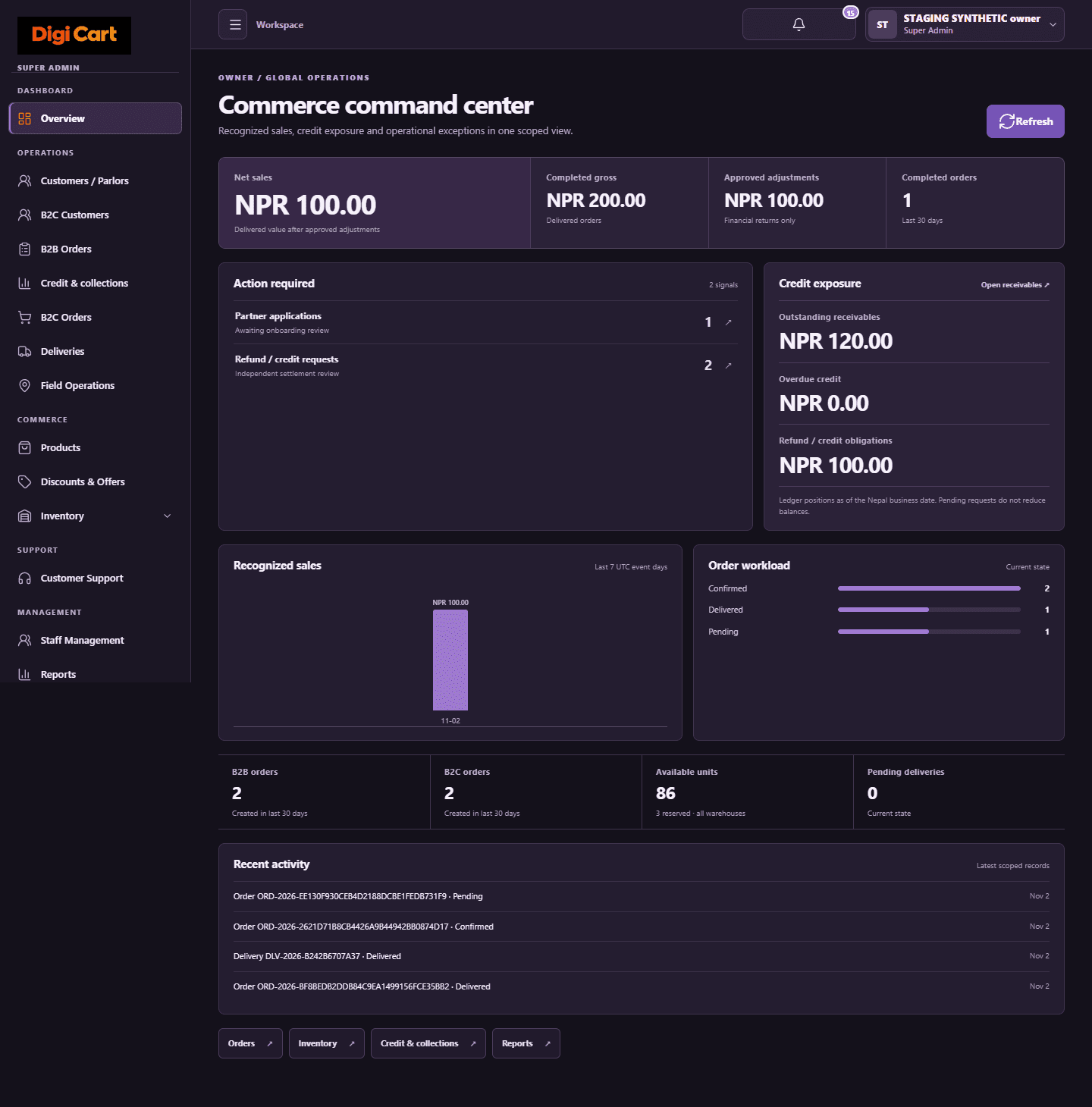
For a wholesale journey, a partner may need to submit an inquiry before receiving terms or access. The authentic DigiCart development preview shows a partner inquiry starting point alongside a commerce operations workspace. It is a development preview and does not imply a verified launch or commercial result.
Treat product information as operational data
Decide who owns names, descriptions, images, variants, availability, categories, and pricing. Define how changes are reviewed and how incomplete products are handled. If information comes from another system, clarify which source is authoritative and how updates move between systems.
Product images need consistent dimensions, appropriate compression, meaningful alternative text, and permission for use. Layouts should remain stable while images load and work across mobile connections.
Follow one order across six separate records
A customer orders the last two units of a product. Create a pending order and reserve two units until a defined expiry. The browser leaves for payment; closing that tab does not cancel or confirm the order. Verify the amount, currency, order reference and outcome against the provider's authoritative response before confirming payment. Store the provider event or transaction reference so duplicate delivery cannot repeat the business action. See OWASP’s payment integration guidance.
Reservation and fulfilment: If both units remain reserved when payment is verified, hand them to picking and record shipment independently. If the reservation expired first, record the payment but route the order to an exception. Do not recreate stock or promise delivery before checking availability. If the buyer cancels before dispatch, release the unshipped reservation once and start refund review; cancellation itself does not prove money was returned.
Settlement and refund: Finance matches a verified payment to the provider settlement, accounting for fees or timing differences. If the refund is requested after settlement, keep the original settlement and record a separate refund reference. Expose “refund pending” until the provider confirms. A returned shipment can affect stock only after inspection, not when the refund changes status.
Test that sequence with duplicate notifications, a late payment, and a refund that fails once. You should end with one order, one verified payment, correct stock, and a reconcilable refund outcome. For comparing integration and operating costs, use the website budgeting worksheet.
Make delivery and collection explicit
Delivery coverage, fees, address quality, tracking, failed delivery, and collection options shape the checkout experience. The platform should communicate available choices before the final step where possible.
If courier services are integrated, document what happens when an external service is unavailable. Staff need a fallback that preserves the order record rather than losing work.
Design customer accounts only when they add value
Guest checkout can reduce friction, while accounts can support repeat ordering, saved details, and order history. Decide based on the business model rather than assuming every store needs registration.
If accounts exist, plan verification, password recovery, session security, profile changes, and deletion responsibilities. Wholesale access may also require approval and role-specific catalogue or pricing rules.
Connect the storefront to operational work
The internal workspace is as important as the public experience. Teams may need search, filters, clear order status, exception handling, notes, permission boundaries, and audit history. Design around frequent actions and make dangerous or irreversible actions deliberate.
ITLead's website and application development service covers both customer journeys and the interfaces needed to operate a digital service.
Build security and resilience into the plan
Validate input on the server, rate-limit abuse-prone endpoints, restrict administrative access, protect secrets, and keep dependencies maintained. Establish backups, monitoring, and a response process.
Third-party services introduce dependencies. Define timeout, retry, duplicate, and unavailable states for payments, email, inventory, and delivery integrations. A graceful failure should preserve enough information for safe recovery.
Choose a focused first release
Prioritize the smallest journey that can operate responsibly. That might include a managed catalogue, clear product pages, one order path, a supported payment method, basic customer communication, and an internal order workspace.
Delay features that are not necessary to validate the operating model. A wishlist, recommendation engine, complex loyalty programme, or multiple integrations can be valuable later, but each adds testing and maintenance.
Prepare content, policy, and ownership
Before launch, confirm product content, contact options, delivery information, return or cancellation terms, privacy handling, and support responsibility. Obtain qualified advice for legal and regulatory obligations; do not rely on generic templates as legal guidance.
Assign owners for catalogue updates, order exceptions, customer messages, provider accounts, analytics, and technical maintenance.
Test complete scenarios
Test on real mobile and desktop devices and include:
- Product discovery and unavailable items.
- Pricing and variant selection.
- Validation and interrupted checkout.
- Successful and failed payment states.
- Duplicate submission protection.
- Order review and status changes.
- Customer communication.
- Refund, cancellation, or return handling where applicable.
Include keyboard navigation, readable focus states, clear errors, and reduced-motion behavior.
E-commerce succeeds as a system
The storefront, operational workspace, providers, people, and policies must work together. Start from the real order lifecycle, make ownership explicit, and release in a scope the business can reliably operate.
To turn an existing commerce process into a considered digital plan, share the customer journey and operational workflow.