
Give two development teams the same awkward scenario and see what each does with it. Imagine an admissions form that must keep accepting submissions on a deadline even if a notification provider is unavailable. One supplier may quote a form and an email. Another may ask how staff will recover, reconcile and acknowledge applications. The useful difference is visible before you compare prices.
Make evidence part of procurement: ask who built the relevant work, what can be shown without exposing client records, and how a comparable decision was tested. A walkthrough of a working increment or an anonymized handover checklist is often more useful than a gallery of finished screens.
A polished presentation can be useful, but it is not enough. Stronger evidence appears in how a team investigates the workflow, defines scope, explains trade-offs, and distinguishes verified work from concepts or development previews.
Define the problem before comparing suppliers
Write a short brief in business language. Explain the users, the job they need to complete, the current process, the main difficulty, and the decision the project should improve. List known integrations, sensitive data, internal reviewers, and timing constraints.
Do not prescribe a technical architecture unless it is already a firm requirement. A capable partner should help translate the problem into a responsible scope.
Evaluate discovery quality
Early questions reveal how a company thinks. Useful discovery covers users, workflows, permissions, content, failure states, support, and measures of acceptance. Be cautious when a supplier proposes a full solution before understanding the operating context.
Ask what the discovery phase will produce. Possible outputs include a workflow map, prioritized requirements, technical risks, interface direction, and a phased delivery plan. These artifacts should reduce ambiguity, not create presentation work with no implementation value.
Review authentic, relevant work
Look for evidence related to your problem, even if the industry differs. A commerce operations interface may demonstrate complex workflow design; an HR workspace may demonstrate role-based information and frequent tasks.
Confirm whether each example is a live deployment, internal product, prototype, or development preview. ITLead's selected work labels its HISABI HRMS and DigiCart material as development previews and avoids presenting unverified outcomes.
Ask the company to explain its role, constraints, and decisions. Respect client confidentiality, but do not accept invented metrics or vague claims as proof.
Understand the delivery approach
A proposal should explain how work moves from discovery through design, implementation, testing, deployment, and support. Ask:
- How are priorities and changes managed?
- How often will working software be reviewed?
- Who approves design and functional decisions?
- How are defects tracked and resolved?
- What testing is included?
- What happens when an assumption is wrong?
Regular review of working increments reduces the risk of discovering a fundamental mismatch at the end.
Clarify technical ownership
The contract and delivery plan should identify who controls the source repository, domain, hosting, database, analytics, and third-party accounts. Ask what documentation and handover are included, how credentials are managed, and whether the organization can move the system later.
Technology choices should be explained in relation to maintenance, team capability, performance, security, and provider constraints. A familiar framework is not automatically the right architecture, and a fashionable technology is not evidence of quality.
Ask direct security questions
Security is a continuing practice. Ask how the team handles authentication, authorization, secrets, dependencies, data validation, backups, logs, and deployment access. For systems with sensitive data, clarify threat boundaries and incident responsibility.
The development company does not replace legal or specialist advice where required, but it should identify technical risks and avoid weakening controls for convenience. ITLead's cybersecurity service focuses on practical risk identification and prioritized safeguards.
Compare communication and commercial clarity
The proposal should state deliverables, exclusions, assumptions, payment stages, change handling, and support terms. A lower number attached to undefined scope is difficult to compare with a proposal that includes discovery, testing, deployment, and support.
Meet the people who will actually work on the project where possible. Notice whether technical concepts are explained clearly to nontechnical decision-makers. Communication is part of engineering quality because an ambiguous business decision eventually becomes an implementation risk.
Plan for operation after launch
Ask who monitors the system, applies security updates, handles support, reviews backups, and manages third-party changes. Define response expectations and what counts as a defect versus a new requirement.
Training and handover should match the audience. Content editors, administrators, support staff, and end users need different preparation. See ITLead's approach to practical training and capacity building.
Score the same admissions test for each supplier
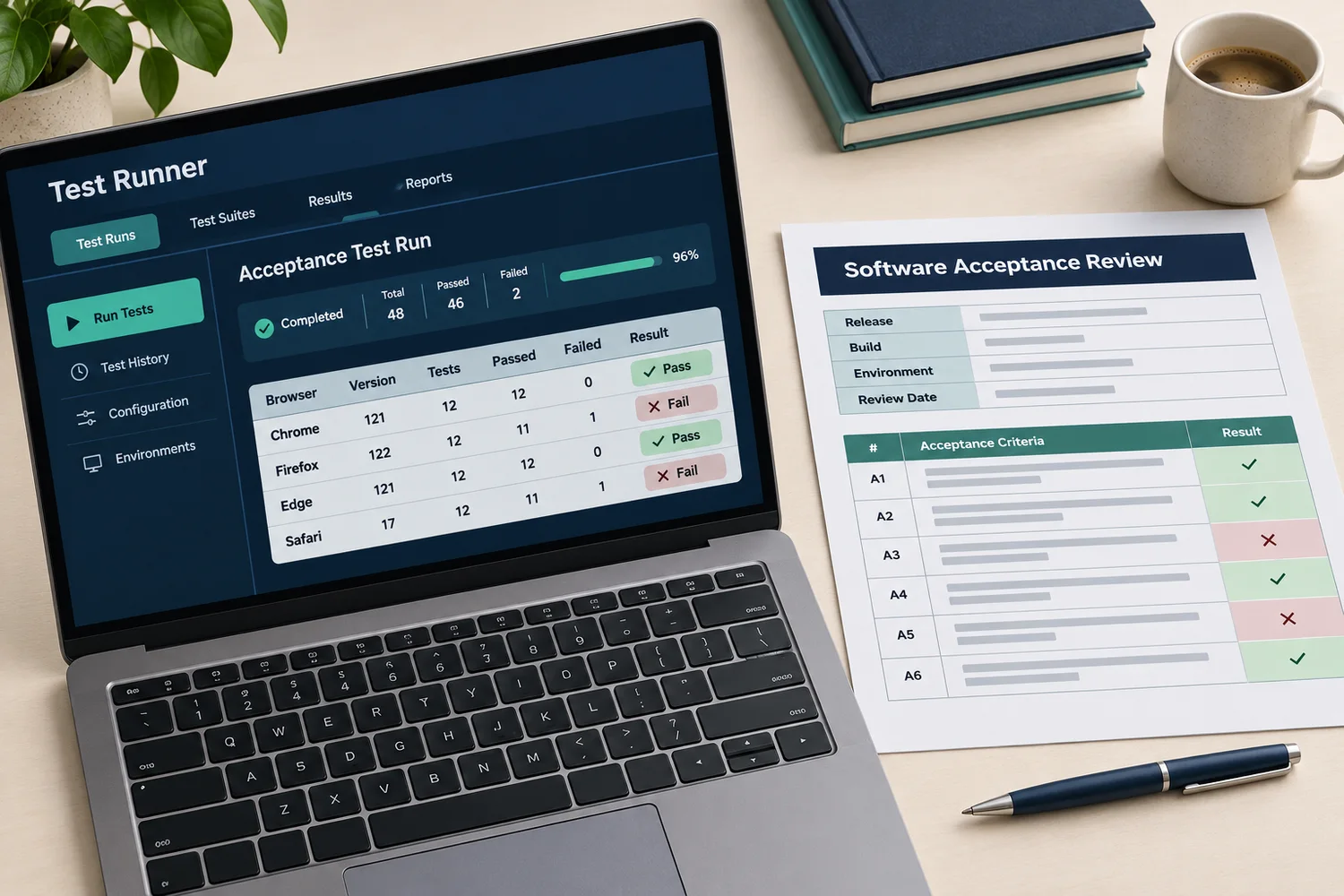
Ask each team to demonstrate a submission while the mail provider is unavailable. The browser should still receive a receipt tied to a saved application. Staff should see one application, a pending notification and a way to resume delivery without creating a duplicate application. Run the demonstration with synthetic records, then ask the team to explain which records prove that it passed.
Reliability, 40 points: Show a stored application, one stable reference, and a notification failure that does not undo the application. Test a refresh and confirm there is still one record.
Handover, 35 points: Require institution-controlled domain and hosting access, an agreed repository or source-delivery arrangement, backup and recovery instructions, and an export staff can use without the vendor. Ask an institutional reviewer to locate the export during acceptance.
Delivery and support, 25 points: Compare the actual outputs: a working staging workflow, a test record, an accessibility check, staff training and a support escalation plan. Score zero for an unsupported promise, half credit for a written deliverable that has not been demonstrated, and full credit for demonstrated evidence agreed in scope. The weights are illustrative. Put the outcomes and exclusions into the proposal comparison before reviewing price.
Choose for the working relationship, not only the pitch
Software projects involve decisions that cannot all be predicted at quotation time. Choose a company that makes uncertainty visible, protects your options, and can explain its recommendations in terms of business value and operational responsibility.
To assess fit, start a project conversation with the problem, users, and current workflow rather than a preselected feature list.